


Trenchcoat review. The Burberry Trench: Crafting an Icon
October 22, 2026Trenchcoat review. There are few garments as recognisable as the trench coat. It has survived wars, changing fashions, new technologies and countless attempts to replace it. The shape is familiar before we even notice the details. A double-breasted front, broad lapels, epaulettes, a belt and those distinctive storm flaps are enough to make the garment instantly legible. Yet the trench coat has never been quite as straightforward as it looks.
At the V&A, The Burberry Trench: Crafting an Icon makes a convincing case for looking more closely. This small display takes a single garment and reveals just how much history, design and cultural meaning can be contained within it.
The exhibition is deliberately concise. It does not attempt to tell the entire history of British outerwear, nor does it wander into a general survey of military fashion. Instead, it concentrates on the Burberry trench and its transformation from practical clothing into one of the most enduring symbols of British fashion. That focus works particularly well. The trench is such a familiar object that it is easy to stop seeing it. Here, its construction and variations are brought back into view. The display also benefits from being free, making it an easy addition to a visit to the V&A rather than an exhibition that demands an entire afternoon.
The story begins with function. That is important because the trench coat was not originally designed to be fashionable. Its appeal came from solving practical problems. It was outerwear intended to protect the wearer from difficult weather, while its military associations gave it a particular authority. The familiar details were not simply decorative flourishes. They belonged to a garment designed around movement, protection and utility.
Trenchcoat review
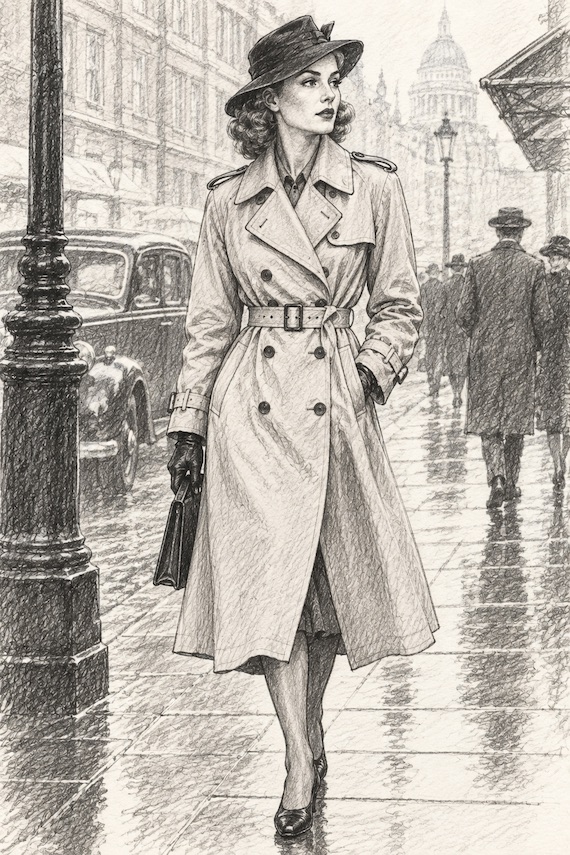
Image AI
That practical beginning makes the later examples all the more interesting. Fashion has a habit of taking useful things and making them expressive. The trench is a particularly good example. Its proportions, hardware and military references have provided designers with a remarkably adaptable framework. It can look severe, elegant, glamorous, eccentric or thoroughly modern without losing its basic identity.
The V&A understands this distinction. Rather than presenting the trench as a static classic, the display shows how much the garment can change while remaining recognisable. Among the highlights is a Burberry womenswear catalogue dating from around 1937 to 1944. It offers a useful reminder that the trench was not simply a masculine military garment that fashion later decided to lend to women. Its history within womenswear is part of the story too. The catalogue also places the garment within the context of a changing fashion industry, where practical clothing could increasingly become part of a woman’s everyday wardrobe.
There is something particularly satisfying about seeing historical fashion through an object such as a catalogue. Clothes can tell us how people dressed. Printed material can tell us how they were being sold and imagined. Together, the two offer a fuller picture. The trench was becoming more than something worn because the weather demanded it. It was becoming a style.
Distinctive Design
Trenchcoat review. This is where the exhibition becomes especially good on the subject of longevity. The trench has lasted because it possesses a rare balance between structure and flexibility. Its design is distinctive without being overly prescriptive. It has enough detail to remain interesting, but enough simplicity to accommodate different fabrics, proportions and treatments.
The contemporary examples demonstrate this beautifully. A men’s mirror-embroidered trench coat from Autumn/Winter 2015 takes the familiar form into much more elaborate territory. Embroidery changes the character of the garment without erasing its origins. The coat still reads as a trench, but the surface gives it a completely different presence.
Then there is the men’s pink metallic silk trench from Spring/Summer 2013. It is difficult to imagine anything further removed from the muddy conditions of a military landscape. That contrast is part of the fun. The trench has travelled a very long way from its original purpose, yet the underlying silhouette remains intact. A garment created for practicality can become extravagant without becoming unrecognisable.
Trenchcoat review
The same point comes through in the women’s purple baroque-print fringed trench coat from Winter 2025. This is fashion taking possession of an established vocabulary and pushing it somewhere more theatrical. The colour, print and fringe are emphatically decorative. The traditional trench has become a starting point rather than a set of rules. That is perhaps the most interesting thing about the display. It demonstrates that an icon does not survive by remaining unchanged. It survives because it can change.
The exhibition also includes a personalised label from a Burberry car coat belonging to British designer Hardy Amies, dating from 1979. It is a small detail, but it adds a human dimension to the story. Labels are easy to overlook when looking at clothes. They are tucked inside garments and rarely photographed in the way that a dramatic sleeve or collar might be. Yet a personalised label can tell us something about ownership, status and the relationship between a garment and the person who wore it.
The Burberry Trench: Crafting an Icon succeeds because it does not pretend that the trench is mysterious. Instead, it explains why such a familiar garment has remained relevant. Its strength lies in the combination of usefulness and recognisability. It has a strong identity, but it also has room for reinvention.
Tension
Trenchcoat review. That may be the secret of its longevity. The trench does not need to choose between fashion and function. It has always occupied the space between the two. The V&A’s display captures that tension neatly, showing how a piece of practical outerwear became a defining fashion object without losing the qualities that made it useful in the first place. For a small exhibition, it has plenty to say. It is informative without becoming heavy, visually appealing without resorting to spectacle and specific enough to make the history of the trench feel tangible. Above all, it leaves you with a renewed appreciation for a garment that has become so familiar that it can almost disappear into the background.
The Burberry Trench: Crafting an Icon is at the V&A South Kensington currently and entry is free.

