


Wes Anderson London Exhibition review
May 30, 2026Wes Anderson London Exhibition review. What an extraordinary show. A real chance to get into the mind of one of film-making’s great auteurs and to see costumes, props, puppets, BTS photos and all sorts of bits and pieces from his idiosyncratic films. There are a couple of Wes Anderson films I love (the short, Hotel Chavalier, The French Dispatch, The Darjeeling Limited, and of course, The Grand Budapest Hotel, since you ask). Oh, and Royal Tenenbaums. OK, so more than a couple.
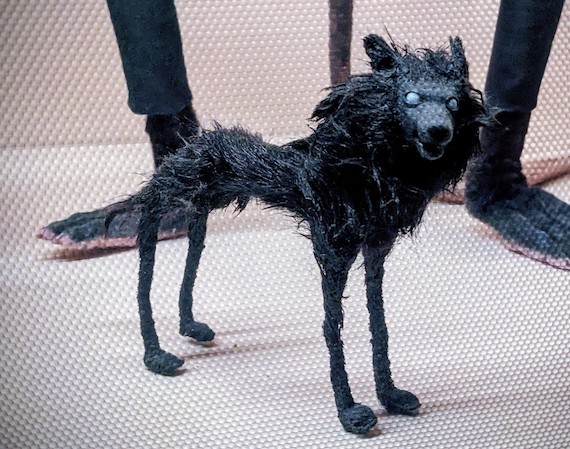
In the other ones, I feel that the characteristic delivery of the actors is just too grating, or in the case of the more recent ones, it’s just as everyone says, nothing new, it’s just more Wes Anderson. And I wanted to love Isle of Dogs, I just couldn’t. However, it’s really dizzying to gaze at the director’s actual notebooks with his tiny writing, the little puppet for the Wolf in Fantastic Mr Fox, and Margot Tenenbaum’s prosthetic finger.
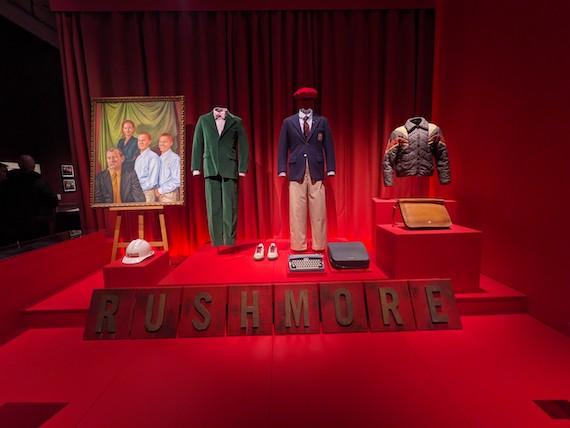
Photo: G Jones
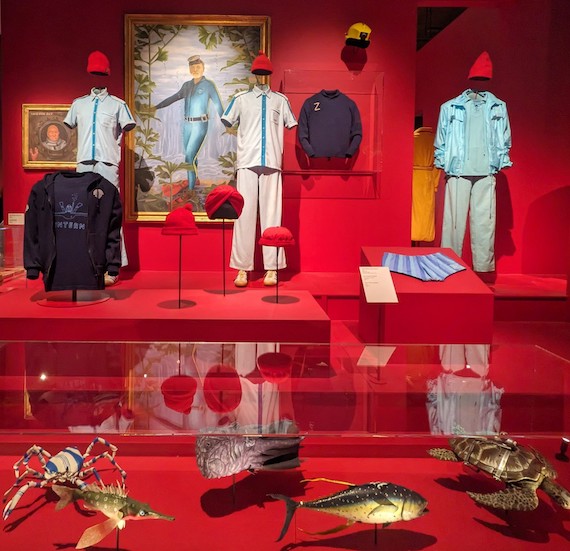
Photo: G Jones
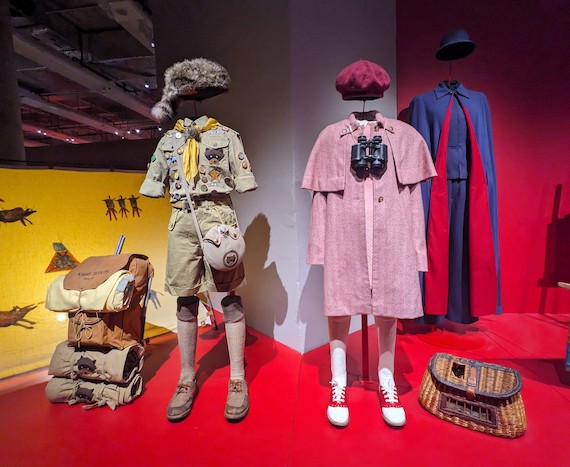
Photo: G Jones
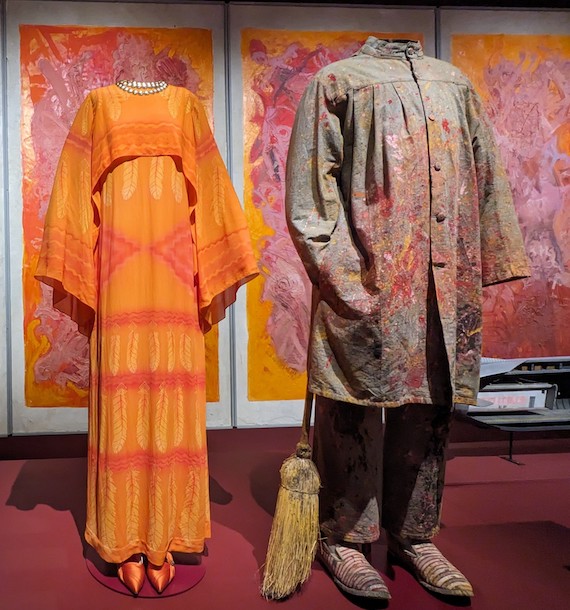
Photo: G Jones
Wes Anderson London review Photo: G Jones
A series of reds
The lighting and design for the exhibition is excellent. Anderson’s famed stylised palette is not actually used. Instead, most of the walls and plinths are shades of red and burgundy, with deeply dramatic lighting. Although the exhibition is thorough, there are not an overwhelming amount of pieces, and these are well-chosen to illustrate different films. Of course, little clips of the films play too.
I especially loved seeing the books and magazines, meticulously created with the right typefaces and bindings, with slightly battered dust jackets where appropriate.
Costume designer Milena Canonero deserves so much credit for the distinctive look of his films. It was she who created the blue and red uniforms for the crew of The Life Aquatic with Steve Zissou, each cast member having a different type of hat or head covering but in the same shade of scarlet. There were closely based on the actual uniforms of the crew of the famous oceanographer and film-maker Jaques Cousteau‘s expeditions. After that, she costumed The Darjeeling Limited, and The Grand Budapest Hotel, for which she won an Academy Award (her fourth).
Wes Anderson London Exhibition review
The exhibition’s greatest pleasure is that it lets you experience Anderson’s precision at a human scale. What can feel, on screen, like an almost abstract perfection is here shown to be laborious, physical, and often small. A film that reads as expansive is revealed through miniatures and maquettes. A momentary graphic detail becomes a wall of drawings, tests, and variants. Even for visitors already versed in the mythology of the “detail-obsessed” director, the density of the archive is persuasive. More than 700 objects are presented across his career. It shows the return of certain typographic instincts, the recurring fondness for institutional uniforms, the love of containers and labels, and the way colour is used to organise feeling.
Costume, in particular, emerges as a crucial hinge between character and composition. Anderson’s films are full of people whose inner lives are expressed through clothes that look both inevitable and slightly too arranged. It’s as if their identities have been ironed flat and pinned into place. Seeing the costumes off-screen, you realise how much of that effect depends on textiles and cut.
Rushmore
Wes Anderson London Exhibition review. A revealing early example is the section on Rushmore. Max Fischer’s wardrobe is laid out with an attention that mirrors the character’s own self-mythologising. Here is his formal school uniform: a navy blazer, tie, and a patch with bees. They are paired with the lapel pins that signal perfect attendance and punctuality. Nearby are the garments that chart his social performance outside the institution: the brown quilted jacket, and most memorably the green velvet suit and bow tie used for more celebratory scenes. The green velvet is not simply a comic flourish. It’s Max’s attempt to dress himself into importance. The exhibition allows you to read that psychology through fabric. It also grounds the costume design historically within Anderson’s practice, noting his collaboration with costume designer Karen Patch on the film, who also worked on The Royal Tenenbaums with him.
Wes Anderson London Exhibition review – Stylisation
As the exhibition advances through the filmography, costume becomes more explicitly a system of power, class, and belonging. The Grand Budapest Hotel material is a highlight. Not just because it is lavish, but because it shows how the film’s fantasy of etiquette is engineered. To create M. Gustave’s “striking purple concierge uniform,” the costume designer Milena Canonero sourced historical clothing to study period cutting and construction. It is stylised, yes. But it is stylised through research, through the study of how garments are built and how authority is worn.
The display includes the concierge uniform worn by Ralph Fiennes. There is the Society of the Crossed Keys pin, Agatha’s costume worn by Saoirse Ronan, and Zero’s concierge uniform. As well as these there is Madame D’s costume worn by Tilda Swinton, with its mink, silk, and velvet.
Wes Anderson London Exhibition review. The exhibition’s handling of Madame D is particularly astute because it shows that Anderson’s eccentricity is not merely whimsical. Madame D’s costume has a weight that borders on funereal. When placed beside the crisp institutional tailoring of the concierge uniforms, it becomes a study in how the films use clothing to encode hierarchy. The surrounding graphic props, menus, notebooks, boxes, and documents help the clothes read as part of a broader administrative aesthetic. It’s a world where every object has an official look and every official look is, in its own way, theatrical.
Wes Anderson London Exhibition review – Mythology
If Grand Budapest demonstrates Anderson’s love of uniforms, the material relating to The Royal Tenenbaums pushes that idea into domestic mythology. The exhibition’s strength is that it refuses to treat costumes as isolated “iconic looks.” Instead, they appear as the visible edge of character design, inseparable from the graphic, architectural, and colour decisions that surround them.
Wes Anderson – The Archives is on at the Design Museum until 26 July 2026.

