


Tracey Emin review
May 30, 2026Tracey Emin review. Walking into the recent exhibition of Tracey Emin at the Tate Britain, you are immediately aware of the weight of reputation moving ahead of the work, shaping expectations before you have even paused in front of a single piece. The rooms feel charged with a kind of retrospective authority, as though you are being asked not only to look but to remember how this work once landed, and how loudly it once spoke. In the 1990s, Emin’s voice cut through the noise with something that felt raw, confrontational, and undeniably new. Her confessional tone, her use of her own life as material, and her refusal to tidy it up for polite viewing created a shock that was also, importantly, a form of recognition. People were unsettled, certainly, yet they were also compelled, because the work felt valid in a way that bypassed more traditional routes to seriousness.
My Bed
Back then, the now infamous My Bed did not simply exist as an artwork, it functioned as a cultural event. It forced a reconsideration of what could be placed within a gallery and still hold meaning. The installation once relied on immediacy, on the jolt of encountering something so unfiltered within a formal space, yet time has altered that effect. The squalor just feels squalid.
Her textile works, particularly the early quilts, remain among the most engaging pieces in the exhibition. They carry a directness that still feels alive despite the passing of time. These works combine text and fabric in a way that mirrors the confessional nature of her broader practice, yet they also introduce a tactile intimacy that softens the more abrasive aspects of her subject matter. You read them while also registering their construction, the layering of materials echoing the layering of memory and experience that the words describe. Moreover, there is something disarmingly sincere about these pieces, as though they were made without fully anticipating the scale of the audience they would eventually reach. That sense of immediacy helps them hold their ground within the exhibition, even as other works begin to feel more tethered to the moment in which they were first produced.
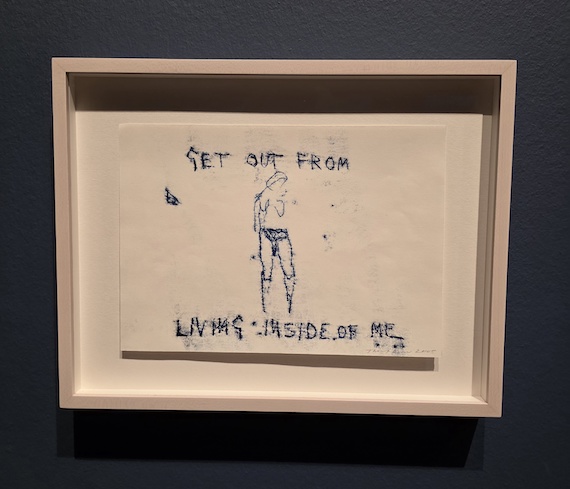
Tracey Emin Review. Image G Jones.
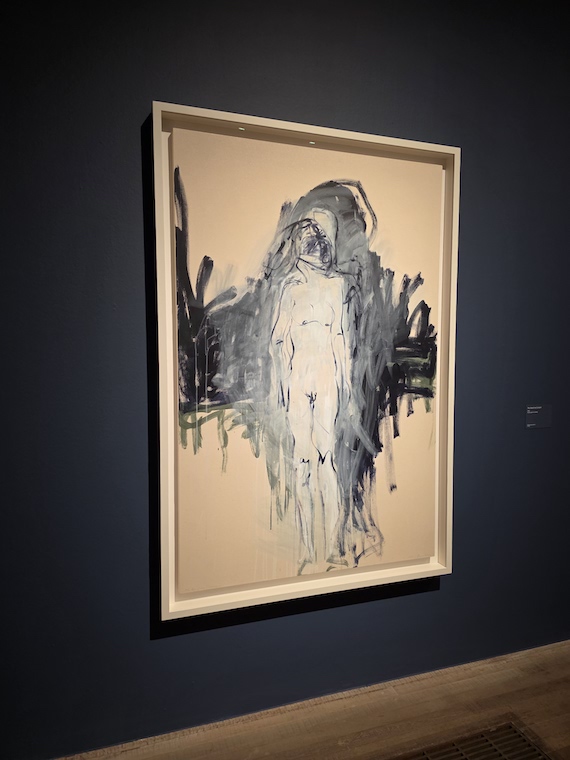
Tracey Emin Review. Image G Jones.
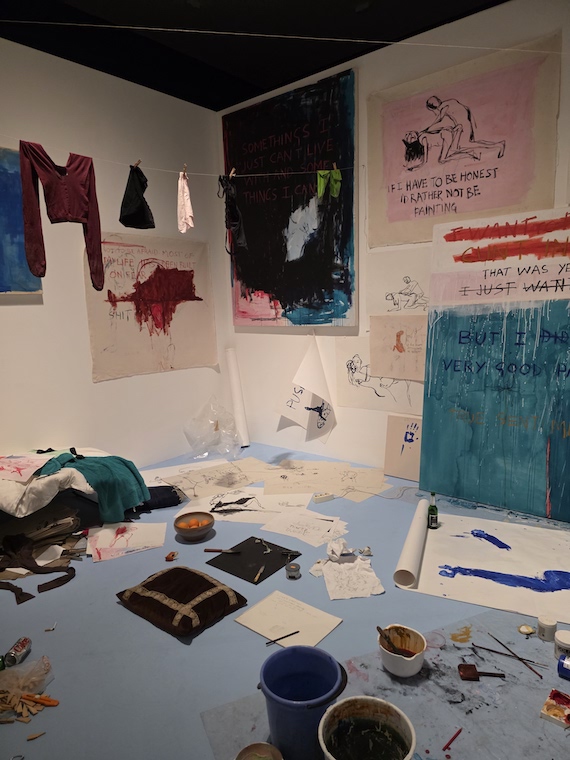
Image G Jones.
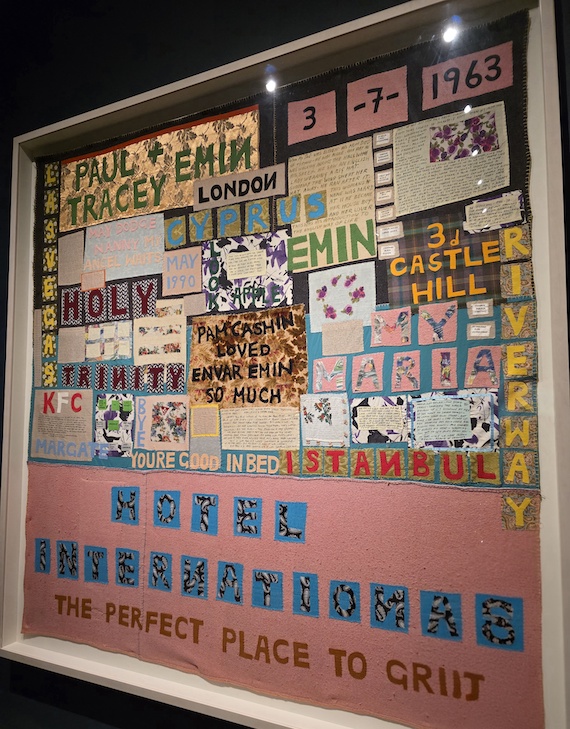
Quilt
Tracey Emin review
The recurring focus on teenage rebellion, on boyfriends, sex, and her own body, once carried a confrontational energy. It challenged expectations around what women could say and show within the art world. At the time, this insistence on personal narrative felt both radical and necessary, pushing against a culture that often demanded distance or abstraction from female artists in order to grant them legitimacy. However, encountering these themes now, you might feel a certain fatigue creeping in. Not because the subject matter has lost relevance, but because its presentation has become overly familiar. What once read as transgressive can begin to feel rehearsed. As though the same notes are being played again without the urgency that originally gave them force. This does not erase their historical importance, although it does complicate their current impact.
More recent works, particularly those featuring Emin’s own body in its present state, introduce another layer to this ongoing narrative. Yet they also risk tipping into something less convincing. The inclusion of imagery that foregrounds her stoma bag, for instance, positions vulnerability at the centre of the work. It asks the viewer to engage with illness, survival, and the body’s fragility.
Nevertheless, the tone of these pieces can feel uncomfortably close to a kind of performative exposure that recalls the logic of social media. Personal revelation is often framed in a way that invites shock value and curious sympathy as much as understanding. This comparison may be unfair, yet it is difficult to ignore. Particularly when the work seems to lean heavily on the expectation of an emotional response rather than building one through its formal qualities. As a result, the balance between honesty and calculation becomes harder to parse. “U OK Hun?”
All That Glitters….
Tracey Emin review. Reading All That Glitters by Orlando Whitfield before seeing the exhibition, as I recently did, adds an additional layer of complexity. It’s not that I didn’t know, but it’s a reminder that forcibly shifted my perspective from purely aesthetic considerations to the mechanisms that shape the art world itself. The book’s account of the early 2000s art market, with its casually inflated prices and its reliance on networks of influence, lingered in the background as I moved through the galleries. Figures like Jay Jopling emerge not just as supporters of artists but as key players in constructing their market value. Often through a combination of instinct, charisma, and strategic positioning. This context does not invalidate the work. It does make it more difficult to view it in isolation from the systems that have sustained and amplified it.
Emin is often described as charming. That quality seems to hover around the exhibition, shaping how her work is received as much as the objects themselves. You can imagine the early encounters, the conversations that led to opportunities. There is a sense that a certain personality as well as a certain practice was being brought into the spotlight. However, this raises an awkward question about how much of the ongoing valuation of her work is tied to its intrinsic qualities. How much is sustained by the need to justify decisions made decades earlier? Once prices reach a certain level, they carry their own momentum. The narrative surrounding the work must expand to support them. Consequently, the exhibition can begin to feel like part of that narrative. It reinforces rather than interrogating the structures that have shaped her career.
Tracey Emin review
Emin has worked across a wide range of materials. She has used neon text, painting, drawing, sculpture, and of course textiles. This breadth is presented as evidence of a restless, exploratory practice. Yet moving through the exhibition, you might find yourself questioning how many of these works truly stand on their own. Some pieces resonate immediately. They hold your attention through their composition, their use of material, or their emotional clarity. Others, however, seem to rely heavily on context, on your awareness of who made them and why they matter within a broader narrative. This imbalance creates a viewing experience that is uneven. It shifts between genuine engagement and a more detached, almost analytical curiosity.
The textiles, again, offer a kind of anchor within this fluctuation. Perhaps because they operate at a scale and with a materiality that invites closer, slower looking. You are drawn into their surfaces, into the interplay between text and fabric, into the evidence of making that remains visible rather than concealed. They feel less burdened by the expectations that surround some of the larger, more iconic works. It allows them to exist with a degree of independence that is refreshing within the context of the exhibition. This does not mean they are immune to critique, although it does suggest that they retain a vitality that other pieces struggle to maintain.
Tracey Emin review
So where does that leave me? Standing somewhere between admiration, scepticism, and a kind of ongoing fascination. It resists a definitive conclusion. The exhibition does not resolve these tensions. Instead it presents Emin’s work as both a product of its time and an enduring presence within contemporary art. However, your response may ultimately hinge on how much weight you give to context, to history, and to the systems that have shaped the work’s reception. If you focus on the objects themselves, you may find moments of genuine connection alongside areas that feel less convincing. If you consider the broader narrative, you may find yourself viewing the entire exhibition through a more critical lens.
In the end, what remains is not a simple judgement. I feel a layered response that reflects the complexity of both the work and the world in which it exists. Emin’s early pieces still carry a charge, particularly in her textiles. Immediacy and material seem to come together in ways that feel grounded and direct. Yet the passage of time, combined with an increased awareness of the art market’s inner workings, makes it harder to accept everything at face value. You are left looking, questioning, and perhaps circling back again, caught between appreciation and doubt.
