


John Galliano film review – John Galliano: High and Low
December 9, 2025John Galliano film review. It’s not unusual for artistic geniuses to have flaws. It turns out that John Galliano’s was an antisemitic streak, revealed in a bizarre rant – amongst other things. This film opens with the subject we are all thinking about – how could you lionise a man who has been convicted of a hate crime?
Rather than showing his highs to convince us he’s a good guy then sliding into his lows, after a brief backstage catwalk sequence we immediately get the cameraphone footage of John Galliano saying, drunkenly “I love Hitler”. A few more terrible sentences follow during a short exchange, ending as he turns away with a sneer, and perhaps in his mind this is his most biting comeback – “You’re ugly”. There is no doubt whatsoever about what he says.
He reflects to camera “It was a disgusting thing, foul thing that I did. It was just horrific.” (Interviewer off camera) “Can you tell us how you think you ended up in that place?’ (a short hesitation, gathering of courage ) “Yeah, I’m going to tell you everything.” Wind back to 1980 and Galliano immediately lights up, telling his story from the beginning, from his childhood – bratty, attention seeking, occasionally cross dressing, ever since he was a little boy.
John Galliano film review
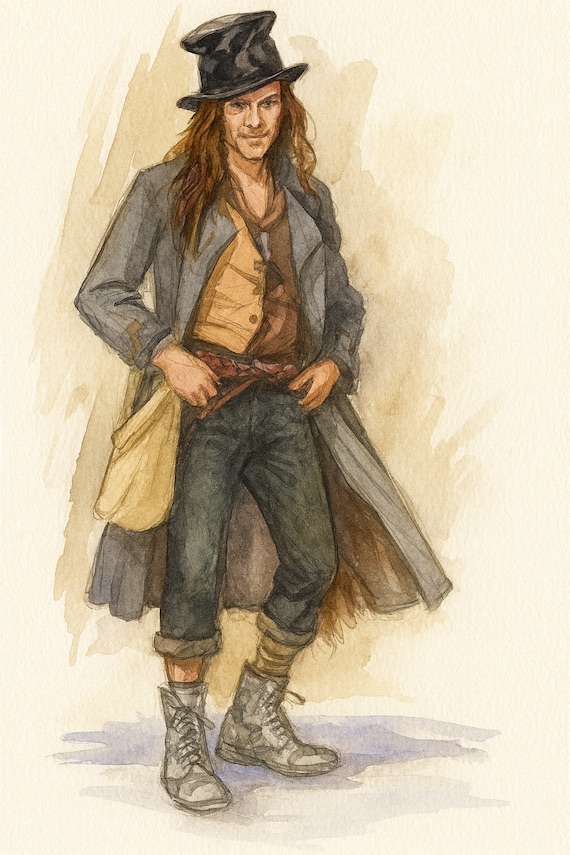
One of Galliano’s looks. Image G Jones/AI
John Galliano is one of the very few people I would genuinely call a genius. His work gives me a thrill like no other designer, and the way that he pulls together immaculate cutting technique with historical references, theatrics, romance and just sheer beauty never fails to entice me. He also had the appearance of someone very fun, charming, and creative. I love that he wore really out-there looks like they were normal. His catwalk bows were legendary. Each time he dressed as something different – an astronaut, a pharaoh, Napoleon, a bullfighter in shocking pink tights, or driven on in a golden carriage. His physique was amazingly honed, and he loved to do photoshoots. Pah to Lee McQueen, chubby in jeans and t-shirt and his quick, shy bows.
In the film, too, lots of people assert his genius, but also how bad he was when drunk ever since he graduated Saint Martin’s in his 20s. He would stand on stages pissing on people, he would get his bum out all the time.
Galliano history
The documentary goes over the well known points about his career – an early backer who he annoyed and who dropped him, a subsequent lack of money until he was saved by André Leon Talley, Anna Wintour and their contacts, to create a collection out of just black crepe fabric, which is all he could afford – the matt side and the shiny side providing contrast. And of course, it was the ideal material for his famous bias cutting, for which he generously credits Amanda Harlech for introducing him to the concept. He also said that when he first went to St Martins, he could draw but not cut. His early fashion illustrations resemble storybook pictures, very charming and with interesting, bold lines. His tutor told him to cut like he drew – with confident boldness.
Kate Moss steps in to say how he directed shows like no other. She didn’t know how to perform on a catwalk at the time, let alone how to portray a character. She was very nervous. It didn’t show, she was wonderful as a sort of 18th century Lolita.
John Galliano film review – just like Napoleon
Interviews are frequently and appositely intercut with scenes from Abel Gance’s 1927 “Napoleon”, which Galliano cites as one of his great early inspirations. In close up, Napoleon cries (voiceover of one of Galliano’s friends recalling his drunken exploits “I thought, this guy is sad”. Napoleon steps out onto an empty stage (Galliano: “I didn’t know what was going to happen next”), a title card from the film rejoicing “At Last” as John is offered the position head designer at the House of Dior.
There is plenty of footage of his gorgeous, gorgeous creations. Photos of him with Nicole Kidman and Princess Diana in some of their most famous dresses, both designed by Galliano. Anna Wintour attests that the slip dresses from his Black Collection influenced fashion for many women for many years.
As well as the rant, there were other scandals too. One was kind of low key. He was announced the head of Dior as a British and not Parisian designer. It made him the first British designer to be admitted to the Chambre Syndicale de la Couture since Frederick Worth, back in 1868. Then there was a much bigger one, when he designed a collection partly inspired by homeless people, which was interpreted as him making fun of them. It was not his intention, he says.
An Overwhelming Schedule
In the film, he speaks about his schedule becoming more and more busy. He had a great number of shows and different collections for both his own label as well as Dior. It grew to up to 32 collections a year. He admits he was an alcoholic, and also addicted to the gym to try to sober up each morning so he could go to work. The designer had a habit of trashing hotel rooms as well as odd incidents, like the time he occupied the Paris Ritz’s lift for four hours, completely naked and insisting he was a lion, growling when anyone tried to enter. He took downers and uppers to help him to sleep and help him to wake up again. When an assistant told the bosses at Dior he needed rehab, she says she was fired.
Meanwhile, the bosses themselves say they offered him time off to pull himself together – six months, even. But Galliano says he doesn’t recall that offer. Similarly, when the scandal broke, Sidney Toledano, his boss at Dior, who is Jewish, says he would have liked to sit him down and talk about it. But he never heard word from Galliano. Though Galliano agrees they never spoke on the subject, he says he tried to reach out but his calls weren’t taken. Either way, Dior dropped him.
John Galliano film review
Of course, after the scandal broke he got treatment – two months at a rehab clinic. According to an addiction expert who was employed by his defence lawyer, Galliano suffered a triple addiction. Alcohol, prescription drugs, and work. The court agreed that he had problems. He was found guilty of public insults based on origin, religious affiliation, race or ethnicity. The sentence was a suspended fine of €6000. In addition just a symbolic €1 damages to each of his victims plus five anti-racism groups. He also paid legal costs for the plaintiffs. It was a pretty low punishment compared to what could have happened, which might have included imprisonment.
However, he was pretty quickly accepted back into the fashion world. He even eventually went back to the Dior archives to see his work. His attempts to be reinstated sound like excuses and lipservice, to be honest. He learned about Judaism, and his fashion friends found a rabbi who agreed to publicly rehabilitate him. It seems more like he laid low and waited for people to forget. When he took the helm of Maison Margiela three years later in 2014 it was very quietly.
It’s a great film, very interesting, and even handed. You really feel like you have an insight into this man and the way he works.


